Black Madonna
Art that Challenges White Christian Nationalism

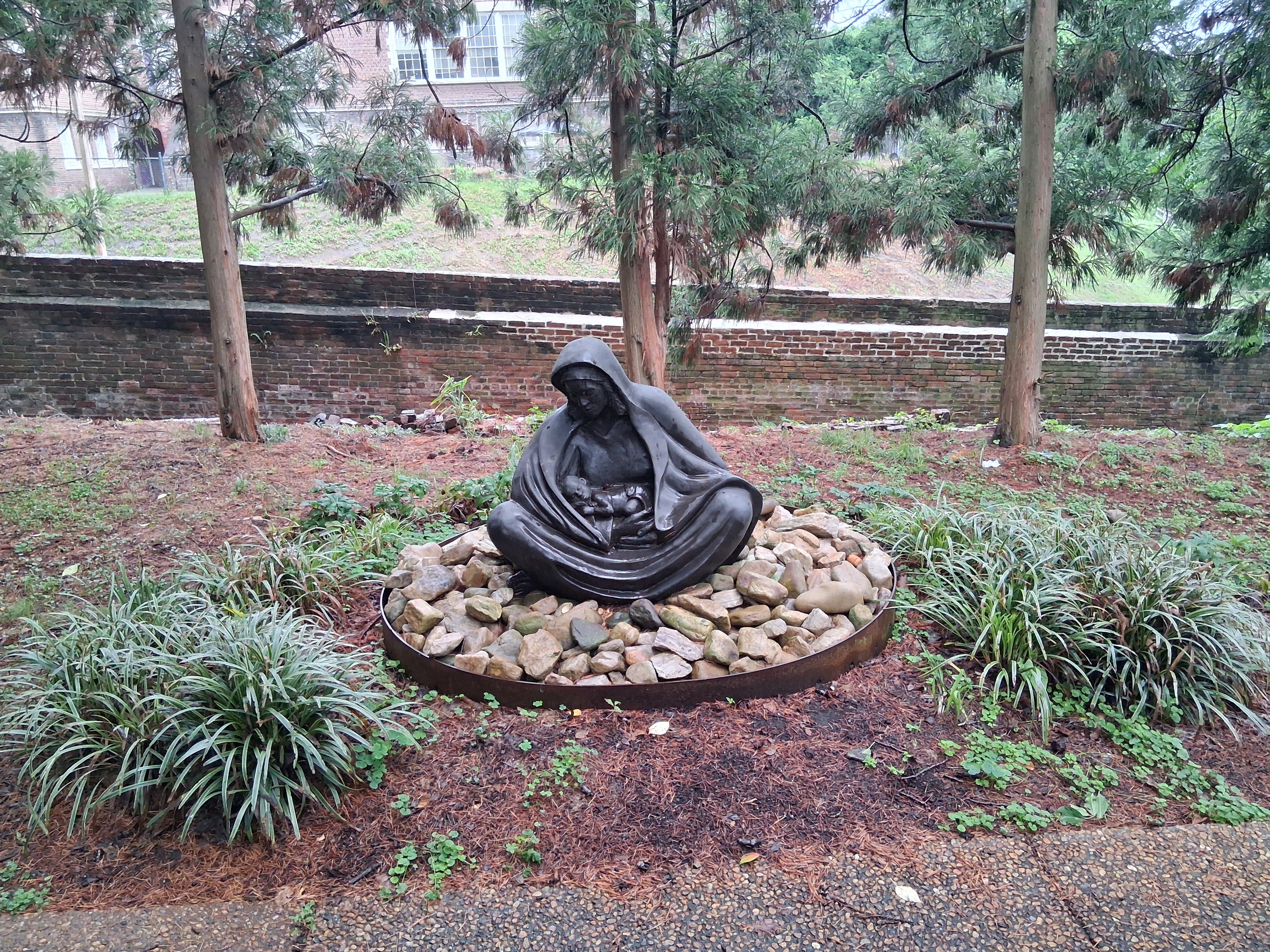
When Jesus talked about God’s kingdom, he used images of a mustard seed. Because I grew up in a suburb, for many years I thought the parable’s message was simply that big things can come from small packages. But then I learned more about how farmers really did not want mustard’s weediness to spread in their fields.
Mustard seeds were about as desirable a commodity as dandelions. I have started to understand the weedy character of the changes Jesus sought both for me personally and for society as a whole. It is not always admirable like a mighty oak tree, but pesky like creeping charlie. Jesus’ parable counters the impulse for “big and powerful” displays, like those of Christian nationalism.
I pondered this recently when I had a few days retreat at Richmond Hill, an ecumenical urban monastery in Richmond, Virginia. The site had been home to Richmond leaders in the 1800s and those they had enslaved. After the Civil War, it became home to a monastery. When the nuns moved to another site in 1987, an ecumenical group of church leaders purchased the property with the purpose of praying and working for racial healing in metropolitan Richmond.
In my short time at Richmond Hill, I met people who were Episcopal, Methodist, Baptist, UCC, Presbyterian, as well as Jewish and none of the above. White, Asian, and Black participants were all seeking honesty by working at the speed of relationship on the slow process of healing. Nothing glamorous or glitzy as they sought to counter white Christian nationalism. I guess Jesus told us to look for mustard seeds for a reason.
Art was part of the process, spreading insight beyond control. One piece of art that was striking to me was Black Madonna in the garden. When the nuns left, they brought their Madonna statue with them to the new home. The ecumenical leaders of Richmond Hill wanted to get an appropriate Madonna statue for the Richmond Hill garden, but the first suggestions all seemed too European. Someone found the Black Madonna by Timothy Schmalz, and it fit the space wonderfully.
For me, I pondered the Black Madonna from several angles, on several occasions. It helped me slow down to imagine the enslaved families that had resided there for years. The pain they suffered, without freedom and in the face of constant indignity. The mothers who sought to comfort their children, aware of the injustice.
Like mustard seeds, the Black Madonna kept spreading new perspectives that challenged the status quo. It kept nudging me beyond my assumptions of “knowing.”
The people at Richmond Hill also shared the stories of enslaved workers who organized to form their own church to sustain themselves and their community. They told about courageous mothers who taught their young to read and gain skills. They shared about the Judy project, named after an enslaved woman whose courage continued long afterwards. The project seeks to unearth narratives that can reframe history.
The people I met in my short time there are intimately aware of the deep pain and insidious tentacles of racism. It is a place where they are seeking to transform - not ignore - themselves and their community into new possibility. To meet racial trauma with deep, ongoing relationships seeking love. It seemed pretty mustard-seedy to me - not exactly what our white Christian nationalism espouses these days.
I am more and more distraught by the blatant racism on display in our country. I am disgusted by the thinly veiled racist actions of our government, rounding up immigrants and incarcerating them in detention camps with inhumane conditions, without due process. Delaney Hall is the latest example in the news, but ICE and DHS spread racial violence and injustice in so many places.
I have often wondered about the various ways to deal with America’s racism, especially these days as the leaders in the Department of Defense try to negate the contributions of Black soldiers and leaders. There are levers of protest, lawsuits, legislation and reparations that are needed to address racism. All are important, even though they can seem small or ineffective right now.
I keep looking for mustard seeds because Jesus told about their worth. I keep remembering the Black Madonna because it tells a truer story than the rhetoric of 2026. I keep finding my imagination opened up by a community at Richmond Hill, striving to live together with space for difference. Across boundaries of race and background, praying for the city of Richmond, they show a better way.
If you would like to know more about Richmond Hill, you can read more here from Tripp Hudgins about the urban monastery: About Richmond Hill
I noticed this piece leaves me feeling heartened to hear that there are still initiatives like this being hosted back east. I spent over four decades in interdenominational work and prayer groups like this you’re describing, Hans. Deep nourishment for the soul.
Out here where I live now in southern Oregon, the racism is profoundly ignored outside of Portland. I stood in a food line on Tuesday with a very tall, Jamaican man right behind me. He was the only person of color in the line and he knew it. And he didn’t begin to trust that I saw him as a fellow human being. I tried to make conversation but his distrust of me was palpable, so I didn’t push.
It will be 20 years this September that I’ve lived in a place where performative liberalism lives on one end of the valley and white Christian nationalism lives on the other. It’s been soul crushing.
I’m so glad you took a retreat in Richmond. Maybe I need to take one.
I'll take mustard-seedy over the alternative any day.
At least it's still growing. :)