Humankind: Human AND Kind
Homo Puppy Needs Better Institutions

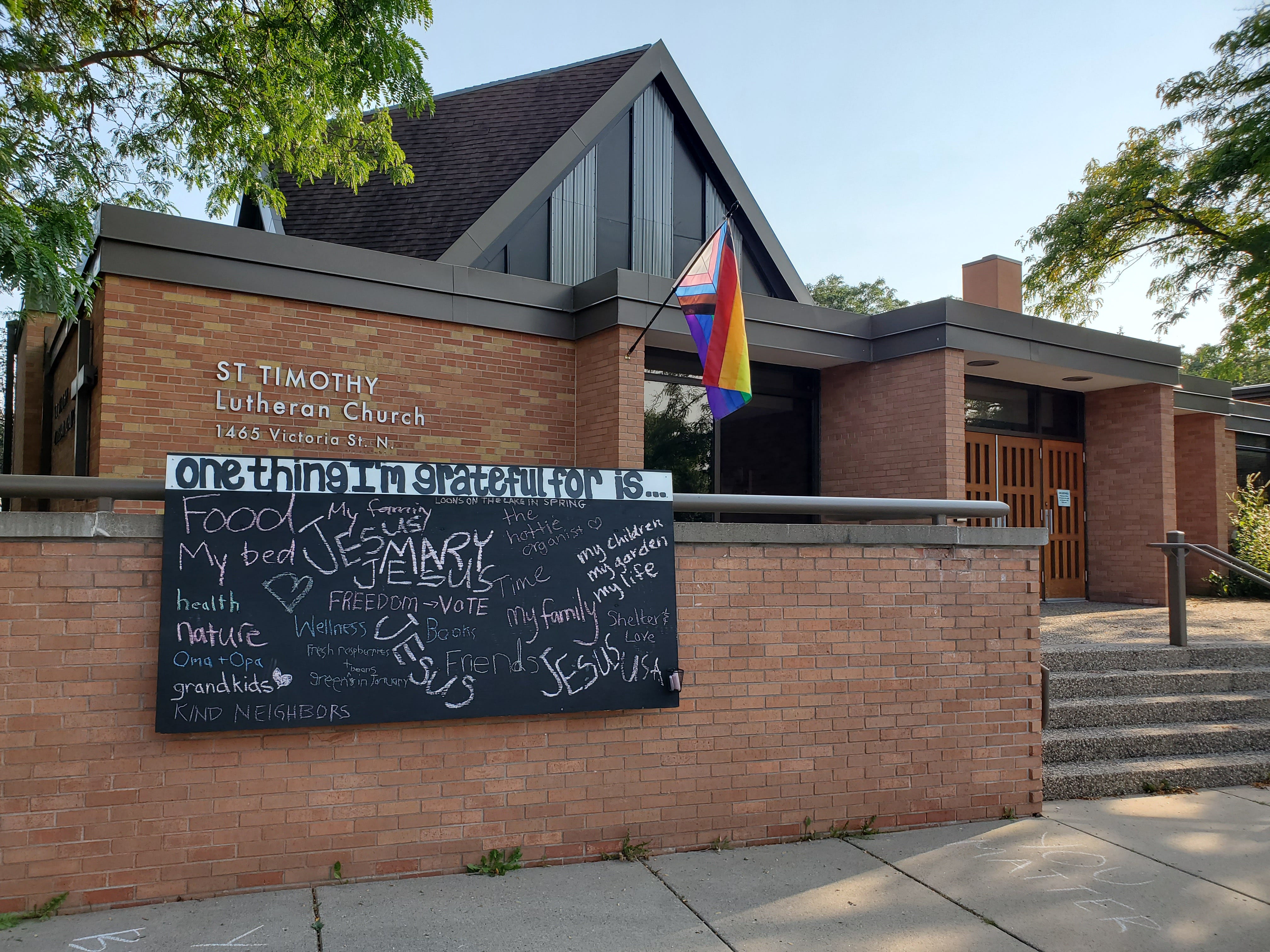
In February, our church had a guest preacher from Interfaith Action of St Paul, Rev. Rachel McIver Morey. She is energy personified, so I was looking forward to it. That day, she was battling bronchitis so was at maybe 70% of her usual energy, which was still more than I achieve at my best.
In her sermon, she talked about Rutger Bregman’s book, Humankind. February found Minnesota in the depths of “Metro Surge” where Minnesotans were responding with amazing non-violent courage and neighborliness to the brutality of ICE actions on our streets. Minnesotans were proud to be Minnesotans just then, in contrast to thugs.
Morey told us, “You’re not that exceptional.” I thought it was a cheeky way to warm up a crowd :). She said there is more goodness in humankind than we usually realize, and referenced Humankind. Honestly, her message connected Bregman’s themes so evocatively that I picked up the book. Reading Bregman’s work, it seems like he has two main foci.
First is that human beings are generally better than we assume. We often assume that, left to their own devices, people at their core are like the boys in William Golding’s Lord of the Flies. Yet Bregman shares story after story where people performed admirable actions despite challenging circumstances. Bregman tells about Peter Warner and Mano Totau, whose friendship started on a deserted island as the complete opposite to Golding’s novel, and has lasted for decades.
I love the chapters where Bregman writes about Dmitri Belyaev and Lyudmila Trut, with their scientific research in the USSR that suggested human success comes not so much because of fierce competition with “survival of the fittest” as individuals, but because of our “homo puppy” evolution.
Bregman focuses more on “survival of the friendliest” as the reason for human success. Rather than a lone wolf narrative, Bregman shows how our collective work together with kindness (seeing we are kin - homo puppy) is what drives human development. Bregman keeps showing research and insightful stories of how kind human beings flourish - human-kind.
Bregman brings compelling counterpoints to the usual interpretations of Stanley Milgram’s experiment with the shock machine, and the murder of Catherine Genovese in New York. They do not show that human beings are horrible or uncaring, after all. There is an underlying kind-ness to human beings that runs counter to our jaded impressions of humanity.
The second focus for Bergman is how often our institutions are failing us. Our institutions fail to provide the needed structure or systems to let our “homo puppy” character thrive. Power corrupts in systems that are built to reward wealth and status and a certain kind of power. There is a mismatch between our capacity for empathy and what powerful people can pull from us because of it. The powerful prey upon our homo puppy character. There is cynicism that comes with power and erodes human well-being.
Bregman argues that while human beings are better than we think, our institutions often set us against each other. This seems to be the case as I look around my country in 2026. All around me I see people who are coming together to support neighbors with food or rent assistance. People are standing up for immigrants. People are finding creative ways to care for one another with trust and joy. Homo puppy is in full display there.
But our institutions? The current administration is part of a trans-national syndicate, focused on graft to enrich themselves and their techbro allies. Congress has become a support system for corporate America by cutting out anything that serves actual people with food or education or health care or science. Anything violent (ICE, war, weapons systems, detention centers) is supported while people’s well-being (Medicaid, Veteran’s Affairs, housing) is disregarded. The Supreme Court has exercised its completely racist playbook to take away voting rights while some of the justices take bribes (in the form of trips or “gifts”).
Our institutions are clearly failing us. They are trying to pit us against each other. But the most pressing issues are not red versus blue, nor liberal against conservative. The institutions keep kowtowing to monied interests that benefit from distracting us by the straw man of divisiveness while they accumulate more cynical power. That is evident.
This does not mean, however, that we do not need institutions. Bregman is clear that we need to build better institutions. We need to build institutions which return again and again to the task of caring from the ground up. For society. For sustainable energy. For the environment. For the vulnerable.
I see this energy day after day as our little church responds to people with daily life needs. Sometimes we are able to help with food or rent, but other times the best we can do is honor the humanity of these people when we do not have the resources. Through our congregation, I understand Bregman’s focus on human and kind as one word - humankind - while decrying the predicament that our misguided institutions put us in now.
We can build better, more responsive institutions. We see this in the pods of Singing Resistance forming around us and responding to neighborhood needs. In wisdom shared through legal work on behalf of immigrants. In people organizing for election integrity. All around, I see the goodness of people who feed hungry folks and send bags of food home with elementary school children so their families have food on the weekend when there are not school lunches. People organize ways of rent assistance for those who have no other options.
So we can build better institutions. Now is a time to highlight the capacity for humankind from our homo puppy character while we work on building responsive, responsible institutions. 2026 will not last forever. We can once again learn how we all do better when we all do better.
Most of the cynicism about human nature is built on a foundation that was always shaky. Golding wrote Lord of the Flies as a moral fable. BTW, I love the Netflix series on this. Milgram's experiment has been so reexamined that the original conclusions barely survive scrutiny. Bregman is being rigorous. The evidence for human kindness is actually stronger than the evidence for human savagery, and we built entire political and economic systems on the wrong assumption. Thank you for this bro :)
I believe I understand where you are coming from and appreciate you taking the time to write it. A small difference for me is that I do not see either a world of the strongest or kindness but see both, most often not coexisting but sometimes they can even for a moment.