Let Us Become Human
We Are Not There Yet

I consider myself a Christian humanist. Some people find that combination confusing. Can one be a humanist while trying to follow Jesus’ way? Can one be Christian while espousing humanist ideas? These days Christian nationalism has muddied the waters, but I am still finding my way.
One of the main parts to my faith personally says that God became human in Jesus, a first century Palestinian Jew. To be clear, the point is not that my Jesus can beat up your Buddha or Moses or Mohammed or Darwin. The point is to turn my eyes to see the human beings who are here, now. Who need food, love, joy. Christian humanism is a way of affirming how I can find God among human beings.
In mystic terms, this conviction allows me to be non-literal and to be attentive to reality beyond static words and categories. God-become-human is a weird phrase that opens me to human life. Here. Now. For me, the particularities of human life are open to discover. It may not do that for you. That’s okay. I’m just saying what is core for me.
For me, Jesus was one who was capable of love and sorrow and sickness and death and laughter and all that is human experience. Maybe he liked poetry. Maybe he would have ridden a Harley. Maybe he ate mushrooms. Maybe he didn’t like chipotle peppers, or U2, or dark chocolate.
In ethical discourse, faith that God became human matters because it calls me to ethical decisions about human flourishing. Physical health, communal well-being, and spiritual life are intertwined for me. Respect for the dignity of others, and seeking justice and love are central to ethical considerations because of this.
And for me, human is not separate from “nature” or other creatures. We are human creatures, totally interconnected with the carbon life forms all around us. Yes, evolution is how we came to be human beings through the millennia of life’s torturous path.
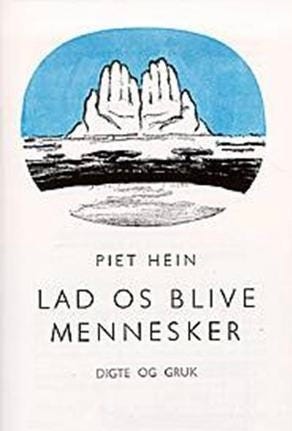
One author I return to again and again is Piet Hein. He was a Danish polymath who wrote poetry, did artistic and architectural designs, and was a humanist in a path I admire. He wrote thousands of Grooks in Danish, and hundreds in English, too. They are often in short, pithy verse that offer both humor and often surprising insight. One of his Grooks is about becoming human, and a rough English translation would go like this:
Come, let us become human
Said an ape to its neighbor.
It was a sunny summer day
Millions of years ago.

It happened as they agreed, and now and then
On our long, wandering journey,
We ask ourselves and answer yes,
We notice some change happening!

And the absurd wonder happens
In our hearts as they evolve,
That the more human we become,
The more we know we are not done yet.
It’s better in Danish, but what I love about Piet Hein is the awareness that becoming human is a process. It is not a preset identity. I love how Hein recognizes that the more we become human, the more we see our limits. The more we see there is still growth ahead. We are still becoming human.
Part of what I dislike about many of the promises that tech bros offer these days is their disdain for real human beings. They seem to promise that tech can help us not be human, not be limited, not need others. Also it seems that tech will take away our characteristics that are unique, quirky, even a bit unruly.
Transhumanism is another topic for a different post, but it certainly seems a misshapen part of the tech focus that wants us to rise beyond our humanity. The apes did not say to one another, “Come, let us become cyborgs.” I hope we do not say that to one another, either.
During the Vietnam war, Piet Hein also wrote another Grook (with LBJ in mind):
The noble art of losing face
May one day save the human race
And turn into eternal merit
What lesser minds would call disgrace.
It would be possible to imagine the relevance of this Grook today in reference to certain leaders, don’t you think? It seems a very important step on the path of becoming human together - to be able to recognize our limits and our need for one another.
I find promise in the imagination that we can turn to one another again and say, “Come, let us become human.” If we are honest, we will also find that there is plenty of change we notice, but we are not there yet.
I like the idea of “becoming human” as a verb rather than a noun. We talk so much about defining humanity. Most of us forget what that looks like in practice.
And the tech section made me laugh because yes, we do seem to have a recurring fantasy that the next invention will finally solve the inconvenient business of being a person.
“Come, let us become cyborgs” 😂 I feel like there is a startup pitch deck somewhere that begins exactly that way.
Oh! How we need “the noble art of losing face” in our world today. That is radical in our age of revenge, resentment and narcissism. Of course, being a humanist is so much more than this. A humanist who has influenced my life deeply is Pete Seeger. He has been a beacon for me ever since childhood.